Sample validation
Direct-to-Product SKU Identification Rings for Warehouse Inventory Control
A US industrial product manufacturer needed a more direct way to classify and identify more than 250 SKUs through warehouse and internal material flows. Zheye developed a red-anodised aluminium identification ring around the customer's product interface, carrying each SKU nomenclature on a component that moves with the physical item. The project progressed from dimensions, material and colour requirements through iterative type and spacing proofs, first-article approval and a four-SKU sample batch. The samples were delivered with positive initial feedback on appearance, and the customer is now evaluating implementation into its product line. The case demonstrates custom identification from physical interface and controlled SKU data through artwork revision and segregated packing; it does not represent a confirmed high-volume supply programme.
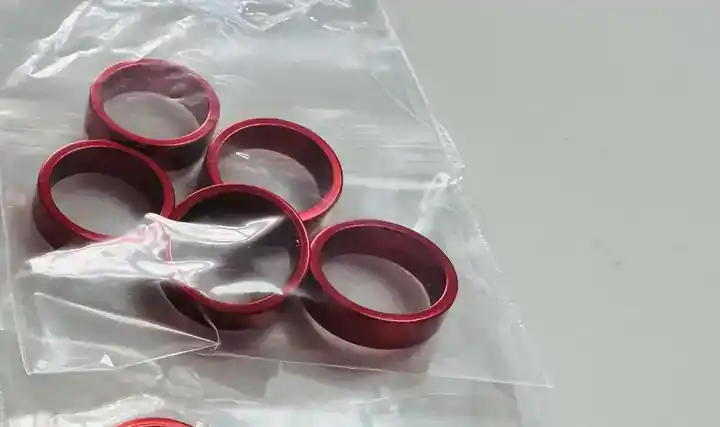
Case record
Value Case ID; CS-002 Warehousing, Logistics, Postal & Cold Chain Industrial Manufacturing & Equipment US industrial product manufacturer United States SKU classification and inventory identification mounted directly on the physical product Multi-SKU custom identification, sample validation and potential long-term supply custom red-anodised aluminium SKU identification rings more than 250 SKUs, with planned annual demand in the tens of thousands interface fit, anodised-colour control, SKU artwork, laser marking, first-article approval and SKU-segregated packing Sample validation and internal implementation review Customer project correspondence and sample-review records from March–June 2026 Publication-safe image without customer or live SKU data required De-identified draft; customer permission is still required before publication Solution-positioning statement This is not a conventional ring relabelled as a warehouse product. It converts the customer's product interface, SKU nomenclature, viewing requirement and multi-SKU supply rules into an identification component fitted directly to the physical product or its defined interface. It provides a stable human-readable identity for receiving, sorting, picking, stock checks and internal issue, without replacing the customer's warehouse system, regulatory labels or automatic data carriers.
The customer's inventory-identification job
The customer manages more than 250 SKUs, each requiring its own product nomenclature or model abbreviation. For warehouse, material-control and line-side teams, the practical question is not simply whether a label exists. The identity must remain with the correct physical item and make closely related products easy to distinguish. Job performed by the ring the SKU identity remains on the item after transport packaging is removed. helps operators place visually similar products into the correct stock group. provides a direct visual checkpoint when material is selected. reconciles the item nomenclature with the SKU on the count list. supports a final model check before internal delivery and use.
Why a direct-fit identification ring was selected
The project does not suggest that conventional labels are unsuitable in every situation, nor does it replace packaging labels. The customer evaluated a ring because the product offered a defined circular interface. The identification component could therefore travel with the item rather than remain only on an outer carton, storage location or temporary document. Physical interface The ID, OD and height have to match the customer's product so the ring can be fitted without interfering with the product's intended function. Information interface Each SKU nomenclature comes from a controlled list and must remain legible within the available circumference and height. Supply interface As the SKU count grows and releases are scheduled, colour, artwork revision, quantity and packing have to remain consistent between orders.
Sample-project input
The customer supplied a material preference, interface dimensions, marking position, font, character height and four sample nomenclatures. Zheye converted those inputs into a product specification that could be proofed, approved and inspected. Operational meaning fitted directly to the physical item or defined interface. aluminium selected for the customer's sample programme. creates a consistent visual identification layer. matches the available external envelope. matches the physical mounting interface. defines the available marking band. read from the outside after fitting. creates contrasting nomenclature on the red finish. customer-approved font system. keeps a consistent character height within the available band. checks different text lengths and multi-SKU control. Dimensional boundary These values are customer-approved parameters for this sample programme, not universal dimensions for all warehouse identification rings. A new project still requires confirmation against the physical interface, readable area, material and assembly method.
From SKU data to controlled artwork
In a multi-SKU project, the underestimated risk is not machining one ring. It is putting the correct nomenclature on the correct size and the correct physical item. The four live names are represented publicly as SKU-A, SKU-B, SKU-C and SKU-D, while the production logic follows the customer's controlled and approved text. Project action freeze scope, text, case, spacing and quantity. centre text vertically within the 6.35 mm band and balance it around the circumference. use the approved Arial family without artificial stretching. tighten by approximately 10–15% and then equalise number-to-letter spacing. issue a new revision for each change and freeze the approved version. approve artwork, inspect one physical sample, then complete the remaining samples. Nomenclatures vary in length. Fixing character height alone can leave short text too loose and long text too crowded. The customer therefore reviewed font style, character height, spacing, a naturally condensed appearance and balance across all four versions.
Colour consistency and scheduled supply
The customer identified lot-to-lot red consistency as a key requirement after previous variation from another source. For planned annual demand in the tens of thousands with possible scheduled releases, colour cannot be judged from one sample alone. It becomes part of repeat-order continuity. approved sample or approved colour limit as the comparison reference. material, surface condition and project parameters controlled to the approved revision. lot identity retained for traceability and review. SKU list, quantity and artwork revision confirmed before each release. acceptable colour limits agreed before mixing releases from different lots. These controls define a framework for potential long-term supply. They do not mean that the customer's complete SKU range or annual quantity has already been produced.
Multi-SKU sample production and packing control
The first sample set contained four nomenclatures with five pieces per group. Even at a small quantity, the multi-SKU order needs to be controlled as a data-driven job so that a correctly marked ring does not enter the wrong group. freeze approved artwork and group quantity for SKU-A through SKU-D. verify material, red finish, OD, ID and height before production. mark the OD against the released artwork revision. check text, orientation, character height and appearance by group. count and segregate each group, with no mixed staging at packing. match package identity to the pack list. customer reviews appearance, readability and implementation into the product line. Potential long-term programme Controlled SKU master and revision release Quantities released against demand planning Packing by SKU, order, release or internal station Lot-to-lot colour reference and traceability Change control for added, retired and revised SKUs
Sample result and current project status
The samples were delivered. The customer confirmed that the rings looked good and stated that they were evaluating how the rings could be implemented into their product line. This supports continued evaluation of the construction and marking approach, but it does not constitute approval of a production programme. the customer approved the sample artwork. physical samples were completed and delivered. the customer gave positive initial feedback on appearance. the project remains under internal implementation review. a production supply programme has not yet been confirmed. the customer's full SKU range has not yet been covered. no validated inventory-accuracy or picking-efficiency improvement data is available. there is no evidence of connection to the customer's software or automated-reading systems.
Zheye customisation capabilities
Zheye did not force the customer to adapt to an existing catalogue size. The supplied OD, ID and height became sample inspection dimensions. Future projects likewise start from the real mounting interface. 6063 aluminium provides the sample construction, the red anodised finish creates a consistent visual layer, and OD laser marking differentiates the SKUs. These requirements are managed as one approved construction rather than unrelated options. Case, spacing, typeface, character height, width, position and quantity are released through artwork approval rather than left to production-floor judgement. The customer requested tighter spacing, a naturally condensed appearance and consistent visual spacing across versions. Zheye revised the artwork and moved to physical samples only after approval. The sample batch was controlled by four SKUs and quantity per group. If the programme expands, production release, inspection, packing and the pack list should use the same SKU master and approved revision.
Reusable warehouse-identification framework
This case provides an input framework for other direct-fit identification projects, but its dimensions should not be copied to another application without verification. Customer input product photo, mounting position, OD, ID, height, allowable clearance and assembly method. SKU master, display text, case, spaces, quantity and activation/retirement rules. viewing distance, orientation, light and minimum character requirement. material preference, colour reference, appearance limits and environment. annual forecast, release quantity, frequency, SKU grouping and pack-list format. artwork approver, first-article route, revision effective date and change notice. industrial components with similar appearance but different model identity. items that must retain nomenclature after outer packaging is removed. cylindrical product interfaces classified by family, size, specification or use. OEM identification programmes requiring multi-SKU artwork, first article and segregated packing.
Related industries, solutions and local products
Warehousing, Logistics, Postal & Cold Chain Industrial Manufacturing & Equipment - SOL-CORE-03 OEM Nameplate Supply Programs - SOL-CORE-01 Serialized Identification Programs - SOL-REQ-01 Data & Continuity - SOL-REQ-03 Supply Workflow - SOL-SPEC-05 Returnable Asset & Container Identification (the link is to persistent object-to-identity control, not to a container-tag claim) - CAP-03 Variable Data - CAP-07 Custom Size & Shape - CAP-08 Custom Colour & Finish - CAP-10 Custom Marking Process - CAP-14 First-Article Approval - CAP-16 Custom Grouping & Packing Boundary not the standard model for the custom ring. identifies bins or locations, not the direct-fit ring in this case. the hanging-tag construction differs from this ring. The three local products show adjacent material, marking and inventory-control capability. The red aluminium SKU identification ring was developed around the customer's physical interface and should not be presented as one of those standard models.
Project checklist for warehouse, engineering and procurement teams
Which SKUs are difficult to distinguish visually? At which workflow points will the ring be read? Must the item retain its SKU nomenclature after unpacking? How should the delivery be grouped by SKU, zone, line or release? What are the measured interface dimensions, tolerances and assembly method? Can the ring be fitted without affecting product function? How will colour, typeface, spacing and marking position be approved? Which dimensional and appearance records are required for the first article? Who owns and approves the SKU master? How will annual forecast and individual scheduled releases be balanced? How are added or retired SKUs communicated to the supplier? What pack list, segregation and package identification are required for each release?
Candidate website summary
A US industrial product manufacturer needed a more direct way to classify and identify more than 250 SKUs through warehouse and internal material flows. Zheye developed a red-anodised aluminium identification ring around the customer's product interface, carrying each SKU nomenclature on a component that moves with the physical item. The project progressed from dimensions, material and colour requirements through iterative type and spacing proofs, first-article approval and a four-SKU sample batch. The samples were delivered with positive initial feedback on appearance, and the customer is now evaluating implementation into its product line. The case demonstrates custom identification from physical interface and controlled SKU data through artwork revision and segregated packing; it does not represent a confirmed high-volume supply programme.
Suggested website-database fields
Suggested value slug; warehouse-sku-inventory-identification-rings case_id; CS-002 primary_industry; IND-07 secondary_industry; IND-01 solution_type; Direct-to-product SKU identification material; 6063 aluminium finish; Red anodised marking; Laser-marked SKU nomenclature status; Sample validation / internal implementation review publication_status; De-identified draft; customer permission required image_status; Publication-safe image required related_products; IT-09, IT-10, IT-01 — adjacent capabilities only
Need a Similar Solution?
Reference CS-002 and share your application and requirements.